


What to Do If Husband or Wife Sends a Legal Notice for Divorce?
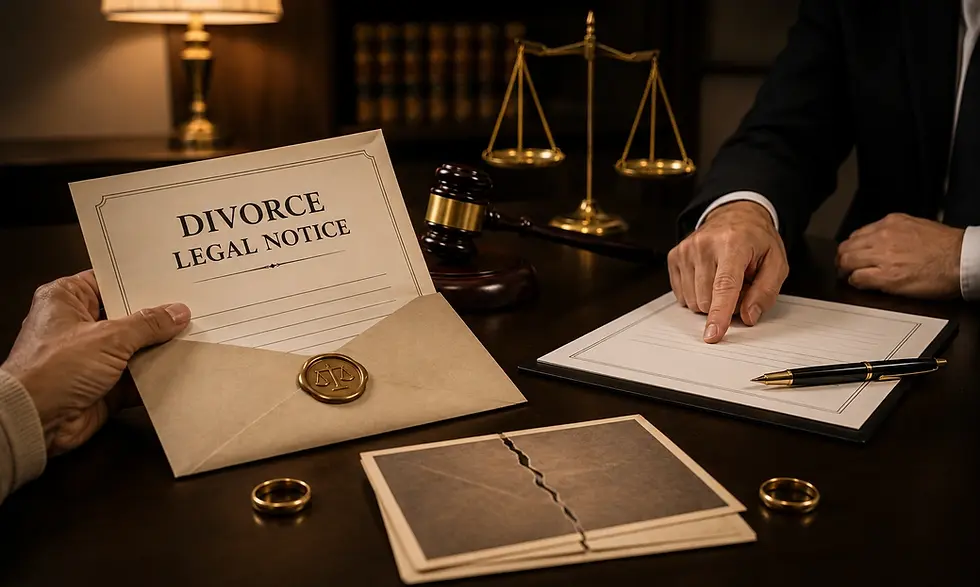
A legal notice from your spouse - or from their lawyer - is one of those envelopes that changes the rest of your day the moment you open it. In more than two decades of handling matrimonial matters, I have seen the same reaction almost every single time: panic first, questions second. "Is my marriage legally over now?" "Do I have to reply immediately?" "What if I don't respond at all?"
Take a breath. A legal notice is not a divorce. It is not a court order, and it does not end your marriage by itself. It is simply the first formal step your spouse has taken to signal their intention - and how you respond in the next few days can genuinely shape how the rest of the case unfolds. This guide explains, in plain language, exactly what a divorce notice means and what to do the moment you receive one.
What Exactly Is a Legal Notice for Divorce?
A legal notice is a formal written communication, usually drafted and sent by a lawyer on behalf of your spouse, informing you that they intend to file for divorce. It typically states the reasons they are seeking separation, may mention issues like cruelty, desertion, or irreconcilable differences, and often asks you to respond within a set period - commonly 15 to 30 days.
Sending a legal notice is not a mandatory legal requirement before filing for divorce in India, but many lawyers use it as a first step for a few reasons:
It puts the intent on record in writing.
It sometimes opens the door to a mutual consent divorce, avoiding a long contested case.
It can be used later in court to show that the sender attempted communication before litigation.
Understanding this changes how you should feel about it. It's a signal, not a verdict - and how you handle the next few weeks matters far more than the notice itself.
How to Respond to a Divorce Legal Notice: A Step-by-Step Guide
Once the initial shock settles, it helps to have a clear, practical sequence to follow rather than reacting on impulse. The four steps below are the same ones I walk every client through — in order, and without skipping ahead.
Step 1: Read It Carefully - Don't React Emotionally Yet
Before doing anything else, read the notice slowly, more than once. Note down:
Who sent it - your spouse directly, or their lawyer?
What grounds are mentioned (cruelty, desertion, adultery, incompatibility, etc.)?
What relief is being sought - divorce only, or also maintenance, custody, or return of property/streedhan?
What deadline has been given to respond?
Many people make the mistake of replying to their spouse directly, emotionally, over WhatsApp or phone call, right after reading the notice. Please don't do this. Anything you say in anger at this stage - in writing or even verbally, if it's later alleged in court - can be used against you. Silence toward your spouse directly, followed by a proper written response through a lawyer, is always the safer path.
Step 2: Note the Deadline, But Don't Panic Over It
Most notices give a response window of 15 to 30 days. This is not a hard legal deadline in the way a court summons is - missing it doesn't mean you automatically lose any rights. However, it does matter for two practical reasons: it shows the court (if the matter eventually reaches one) that you engaged seriously and in good faith, and it keeps you in control of the narrative rather than letting your spouse's version stand unanswered.
If you need more time to consult a lawyer and gather your thoughts, that's completely reasonable - just make sure a reply is sent within a sensible timeframe, not ignored indefinitely.
Step 3: Consult a Divorce Lawyer Before You Respond
This is the single most important step, and it's the one people skip most often - usually because they assume they can "handle it themselves" or that responding informally is enough. A legal notice deserves a legal reply, drafted by someone who understands matrimonial law and can see what your spouse's lawyer is actually building toward.
A good lawyer will help you understand:
Whether the grounds mentioned in the notice are legally valid grounds for divorce under the Hindu Marriage Act, 1955 (or the relevant personal law that applies to your marriage).
Whether a mutual consent divorce is realistically possible, or whether this is heading toward a contested case.
What financial and custody-related claims might follow, so you're not caught off guard later.
How your reply should be worded so it protects your position without shutting the door on negotiation.
If you're still deciding between a smoother settlement and a full court battle, our earlier guide on contested vs uncontested divorce explains the practical difference in time, cost, and emotional toll - it's worth reading alongside this one.
Step 4: Decide How You Want to Respond
Once you've consulted a lawyer, there are generally three realistic paths forward:
1. Open the door to mutual consent. If both of you genuinely want to separate and can agree on issues like alimony, custody, and property, a mutual consent divorce is faster, less expensive, and far less stressful than fighting it out in court.
2. Contest the divorce. If you disagree with the grounds mentioned, or you don't want the marriage to end, your lawyer can draft a reply denying the allegations and setting out your position clearly. This doesn't guarantee the marriage will be saved, but it ensures your side is on record from the very beginning.
3. Attempt reconciliation or mediation first. Sometimes a legal notice is sent in a moment of anger or after a long period of unresolved conflict, and either party may still be open to counselling or mediation before matters escalate further. A well-drafted reply can leave this door open without weakening your legal position.
Whichever path applies to you, the reply itself should always be drafted by a lawyer - not sent as a personal letter. It becomes part of the legal record of your case.
What Happens If You Ignore the Notice Completely?

Ignoring a legal notice does not stop your spouse from filing for divorce - it simply means the case moves forward without your version of events on record. If the matter reaches court, having ignored a formal notice can sometimes be used to suggest indifference or non-cooperation, which is best avoided even if you strongly disagree with the contents.
The better approach, always, is to respond - even if your response is simply to deny the allegations and state that you do not consent to a divorce on the grounds mentioned.
Common Mistakes People Make After Receiving a Divorce Notice
Responding directly and emotionally to the spouse, instead of through a lawyer.
Assuming a notice means the marriage is already over, and making major life decisions in panic.
Waiting too long to consult a lawyer, losing valuable time to prepare a considered response.
Not checking whether other claims are bundled in - such as maintenance, streedhan recovery, or a domestic violence complaint - which need to be addressed separately and specifically.
Discussing the case openly on social media or with mutual friends, which can complicate matters later.
When Custody, Alimony, or a Domestic Violence Angle Also Come Into Play
Divorce notices rarely deal with separation alone. If children are involved, questions of custody and visitation usually follow soon after - our guide on child custody laws in India explains how courts approach these decisions. If maintenance or alimony is mentioned or anticipated, it helps to understand realistic expectations in advance - we've covered this in detail in how much alimony you may get or pay after divorce.
In some cases, a divorce notice arrives alongside - or is followed by - a criminal complaint under Section 498A or the Domestic Violence Act. If that has happened to you, it changes your strategy significantly, and you should read our guide on what to do if a false 498A case has been filed and consider domestic violence and divorce matters together with a single, coordinated legal strategy rather than treating each notice in isolation.
How Sapna Seth Law Firm Can Help You on It
Over 18 years of practising matrimonial law across Chandigarh, Mohali, and Panchkula, I have drafted and responded to hundreds of divorce notices - and the pattern is always the same: the people who consult a lawyer early, before reacting, end up with far better outcomes than those who respond in panic or ignore the notice altogether.
At Sapna Seth Law Office, we review the notice you've received, assess whether the grounds mentioned actually hold up, and draft a clear, carefully worded reply that protects your interests - whether that means opening the door to a mutual settlement or preparing you for a contested case. If custody, alimony, or property questions are likely to follow, we build that into your strategy from day one, rather than reacting to each notice separately. Reach out to us as soon as you receive a notice - the earlier we're involved, the more options you have.
Frequently Asked Questions
1. Is a legal notice compulsory before filing for divorce in India?
No. A legal notice is not a legal requirement to file for divorce, though many lawyers send one as a first step to put intent on record or explore a mutual settlement before going to court.
2. Do I have to reply within the deadline mentioned in the notice?
There's no strict legal penalty for missing the exact date, but a timely, well-drafted reply keeps your position on record and shows good faith if the matter later goes to court.
3. Can I ignore the notice if I don't want a divorce?
You can, but it's not advisable. Ignoring it doesn't stop your spouse from filing for divorce anyway, and it leaves your side of the story unrepresented.
4. Does receiving a divorce notice affect my rights over children or property immediately?
No. A notice by itself doesn't change custody or property rights. Those are decided later, either through mutual agreement or by the court, based on the specific facts of the case.
5. Can a legal notice lead to a mutual consent divorce?
Yes, often. If both spouses are willing to separate and can agree on key terms, a notice can actually be the starting point for a faster, less contentious mutual consent process rather than a long contested case.

Advocate Sapna Seth
Sapna Seth is the founder of Sapna Seth Law Office and a highly experienced advocate specializing in criminal, divorce, and family law disputes. With over 18 years of experience, she has practiced in various courts across Delhi NCR, including the Supreme Court of India, and primarily at the Punjab and Haryana High Court in Chandigarh since 2011. When not advocating for her clients, she enjoys furthering her legal knowledge and spending time with her family.


Comments